

A pre-shipment inspection checks a defined sample of finished goods against agreed requirements before shipment. AQL-based sampling can support lot acceptance decisions, but it does not guarantee every unit is defect-free or replace supplier process controls, product testing and clear specifications.

Start with the specification, not the inspection form
An inspection cannot be consistent if the buyer and factory have not agreed what “acceptable” means. Before production, define the approved sample, critical dimensions, materials, functions, appearance, packaging, labels and destination-market requirements. Identify product-specific tests and acceptance criteria for each.
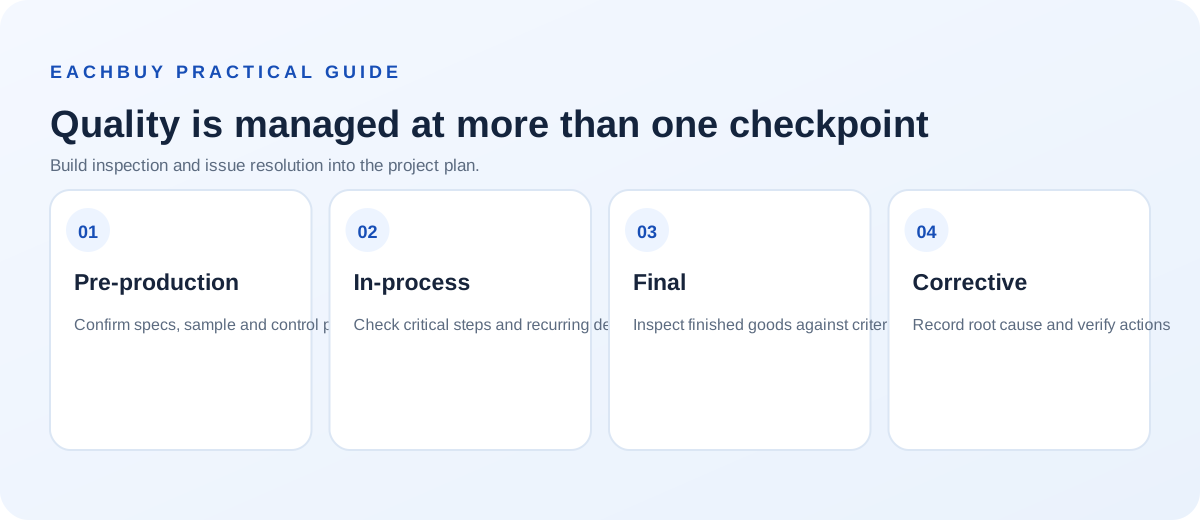
Use checkpoints throughout production
Pre-shipment inspection is one point in a quality plan. Depending on risk and process, useful checkpoints may include incoming materials, first-article or first-off production, in-process checks, final random inspection and container-loading supervision. Not every project needs every checkpoint; select them based on product complexity and the consequences of a defect.
Classify defects consistently
A common approach is to distinguish critical, major and minor defects, but definitions should be written for the product. A critical defect may create a safety or regulatory risk. A major defect may affect function, reliability or intended use. A minor defect may be cosmetic and not materially affect use. These examples are not a substitute for a product-specific defect catalog agreed before inspection.
| Defect class | Example category | How to define it |
|---|---|---|
| Critical | Potential safety, legal or severe hazard | Define product-specific escalation criteria with qualified specialists. |
| Major | Key function, fit, performance or usability failure | Describe the test, expected result and failure condition. |
| Minor | Small cosmetic deviation | Use visual references and tolerances so inspectors can judge consistently. |
What AQL does — and does not — do
AQL is used in acceptance-sampling schemes to help determine sample size and acceptance/rejection criteria for a lot. It is a statistical sampling approach, not a promise that the lot contains no defects. The sampling plan, inspection level, lot size, defect classes and switching rules must be selected appropriately. Do not copy a generic AQL number from a blog without assessing product risk, customer impact and contract requirements.
ISO published the third edition of ISO 2859-1 in January 2026. It describes sampling procedures by attributes with schemes indexed by acceptance quality limit for lot-by-lot inspection. Use the current official edition and qualified quality advice when selecting a plan. See ISO 2859-1:2026.
What a useful inspection report should contain
- Purchase order, product name, SKU and lot / batch reference.
- Inspection date, location, inspector and sample-selection method.
- Quantity produced, packed and inspected.
- Agreed specification and approved sample reference.
- Checklist results, measurements and functional-test results.
- Defect photos, descriptions and defect classifications.
- Sampling plan and acceptance criteria used.
- Pass / fail / pending decision and corrective actions.
Follow through on failed inspection results
A failed or conditional inspection should trigger a decision, not just a report. Identify whether the lot needs sorting, rework, replacement, additional testing or a repeat inspection. Record who pays for the action, the revised deadline and how corrective action will be verified. If the issue traces back to a design or specification ambiguity, update the source document before the next production run.
Compliance is separate from AQL sampling
A pre-shipment inspection does not establish that a product complies with every law or technical standard in the destination market. Product testing, certification, labeling and importer obligations are category-specific. In the United States, CPSC guidance notes updated certificate and electronic filing requirements for many regulated consumer products effective July 8, 2026. Confirm whether your product is covered and review current official guidance.
Official references: CPSC Certificates of Compliance and CPSC General Use Products: Certification and Testing.
Frequently asked questions
Does a passed pre-shipment inspection guarantee every unit is good?
No. Sampling examines selected units. Process control, functional testing, supplier corrective actions and appropriate inspection throughout production all matter.
Should inspection criteria be agreed before production?
Yes. Define the reference sample, tests, defect classes and acceptance criteria before production so the supplier understands the quality target.
Can AQL be used for every product?
Sampling may be appropriate for many lot-based inspections, but the plan must fit the product and risk. Some safety-critical characteristics require specific testing or controls beyond random sampling.